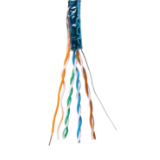
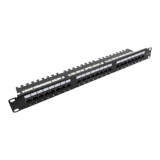
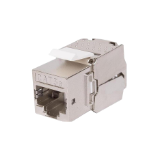
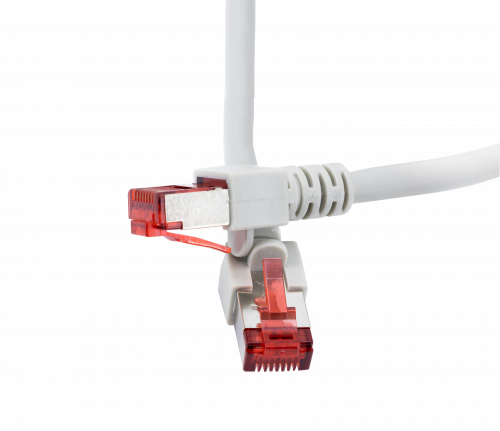
In a standard home or office environment, the level of electromagnetic interference is low. Devices such as computers, routers, printers, or LED lighting do not generate significant interference for copper twisted-pair cables operating under Ethernet standards.
The very design of twisted-pair cabling — that is, symmetrically twisted wire pairs — effectively reduces the impact of external interference and crosstalk between pairs. In practice, this means that:
In such conditions, using shielding rarely provides measurable benefits.
It should be emphasized that an improperly grounded shielded cable can perform worse than an unshielded one. A shield without proper grounding does not fulfill its function and may become a source of problems.

Interference issues may arise when a network cable runs parallel to power lines over several meters. The induced electromagnetic field can then affect transmission parameters — especially at higher operating frequencies.
In practice:
In residential installations, UTP often remains sufficient; however, in tight cable ducts, shielding can increase the transmission safety margin.
Industrial environments are characterized by high levels of electromagnetic interference. Electric motors, inverters, power converters, and welding equipment generate strong interference pulses.
In such conditions, the lack of shielding may result in:
In industrial installations (e.g., industrial Ethernet, PLC control systems, monitoring), shielding is often a design standard rather than an optional feature.
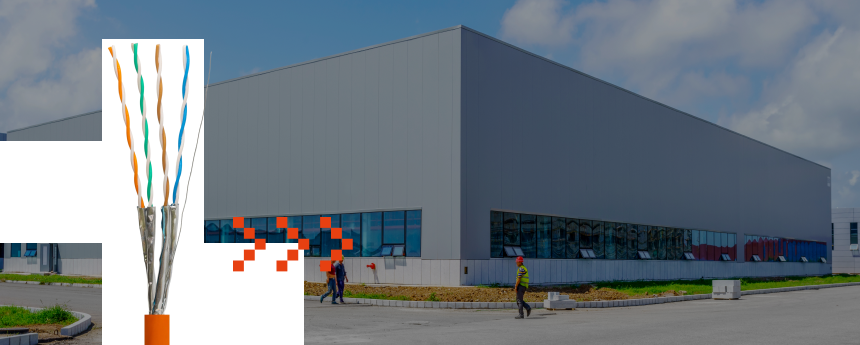
At 10 Gb/s transmission, the requirements for the transmission path parameters are significantly more stringent than at 1 Gb/s. Tolerance for crosstalk and external interference is reduced.
In practice:
Shielding is not always mandatory, but it increases the stability of installations operating close to the limits of standard specifications.
In the vast majority of home and office installations (estimated at 80–90%), UTP cable provides fully stable and standards-compliant network operation.
Shielded cable is justified when:
The most common design mistake is choosing a shielded cable “just in case” without ensuring proper grounding and compatible components (patch panels, outlets, connectors). In such a configuration, the shield not only fails to improve performance but can also increase installation complexity without delivering any real benefit.
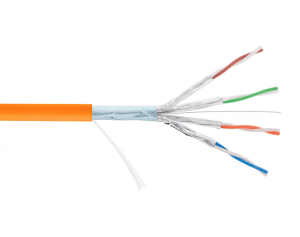
securityNET cable F/FTP cat. 6A LSZH B2ca 500m
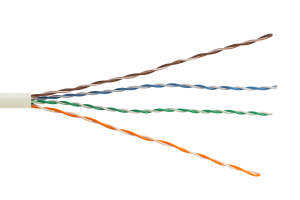
securityNET U/UTP Category 5e 350MHz PVC cable 305m
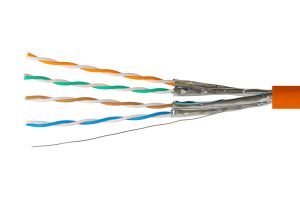
securityNET U/FTP Category 6A LSZH Dca cable 500m
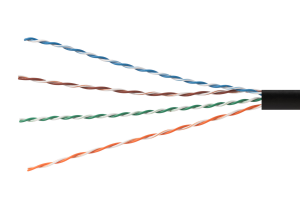
securityNET U/UTP cable Category 5e PE outdoor dry 500m
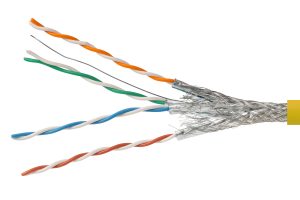
securityNET S/FTP Category 7A LSZH Dca cable 500m
Brochures
Key Elements for Ethernet Network

Marketing materials
SecurityNET 2022 cable catalog

SecurityNET logo