Understanding the CPR Directive in Legal Terms
Regulation (EU) No. 305/2011 (CPR) covers all construction products intended for permanent installation, including cables and wires, in construction works such as residential buildings, public buildings, and civil engineering structures.
As a result of implementing this regulation, cable manufacturers are required to issue a Declaration of Performance (DoP) and to affix the CE marking to products intended for construction works in accordance with the requirements of Regulation (EU) No. 305/2011.
The Regulation officially entered into force on 1 July 2013. However, with regard to fire safety for cables and wires, the directive refers to the harmonised European standard EN 50575:2014, for which the final date of implementation was set as 1 July 2017.
Norma EN 50575
covers power, telecommunications, and signal cables intended for permanent installation in construction works. Based on it, a Polish standard was published on 27 December 2016.
PN‑EN 50575:2015-03P
covers power, control, and telecommunications cables and wires, as well as cables and wires for general applications in construction works with a specified fire performance class.
Cable Requirements under CPR
From 1 July 2017, all installation cables have been classified as construction products subject to relevant regulations. The new requirements oblige manufacturers to prepare and make available a Declaration of Performance (DoP) and to affix the appropriate CE marking to products covered by the standard.
The European standard EN 50575 specifies requirements for performance under fire conditions, as well as test and assessment methods for power, control, and telecommunications cables used in construction works with a defined fire performance class.
Cables and wires covered by this standard are intended for the supply of electricity and telecommunications applications in buildings and other construction works, with the aim of limiting the generation and spread of fire and smoke.
The rules set out in EN 50575 require manufacturers (as well as importers and distributors) to have their products tested by notified certification bodies or laboratories in order to obtain the relevant certificates confirming the fire performance class, and to prepare a Declaration of Performance (DoP) to verify the product’s Euroclass.
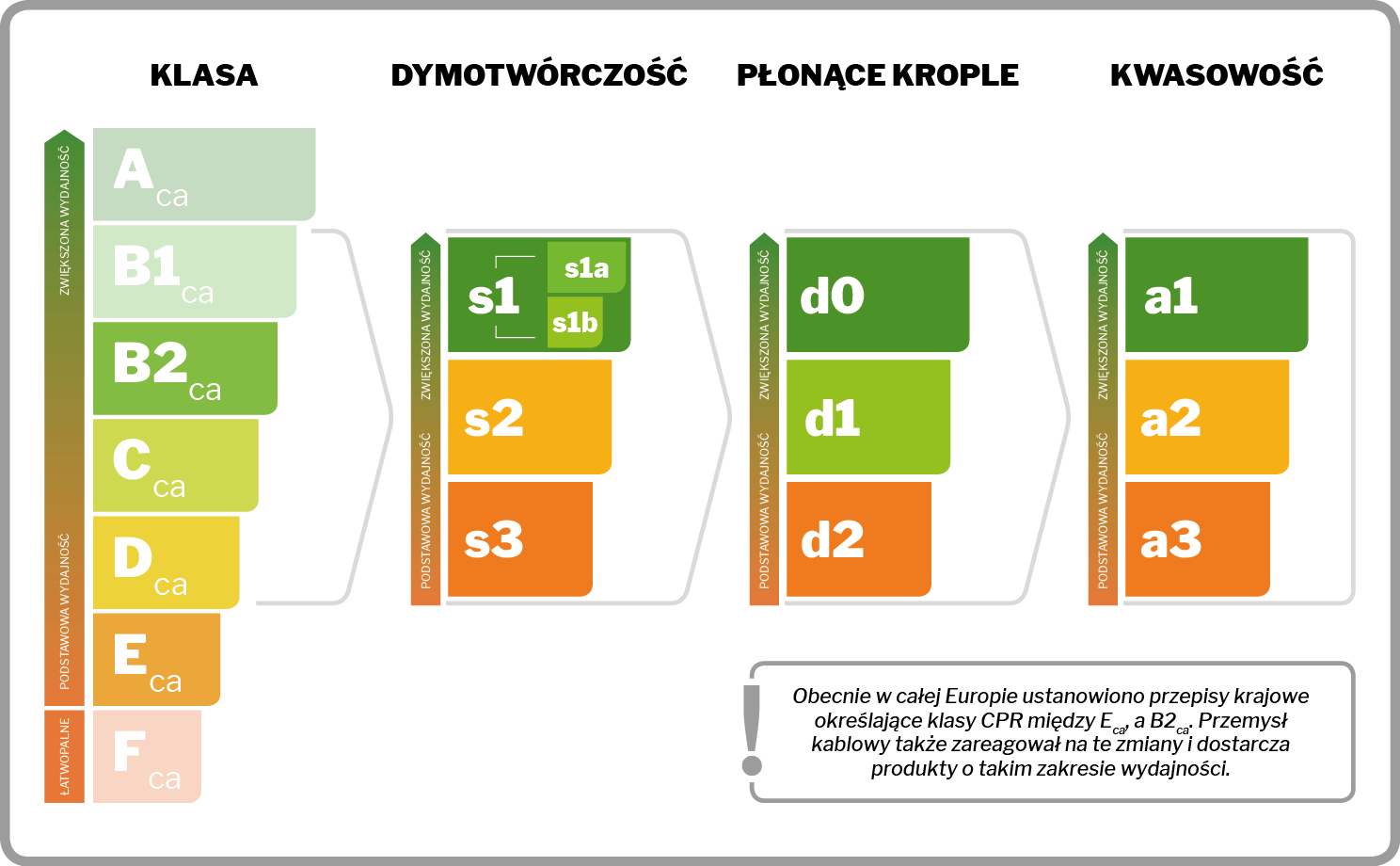
The Euroclass system enables the assessment of the reaction to fire of construction products (including ICT and telecommunications cables and wires) and ensures they are classified according to the same principles and criteria across Europe.