B2ca -s1a, d0, a1 Explained: What You Need to Know
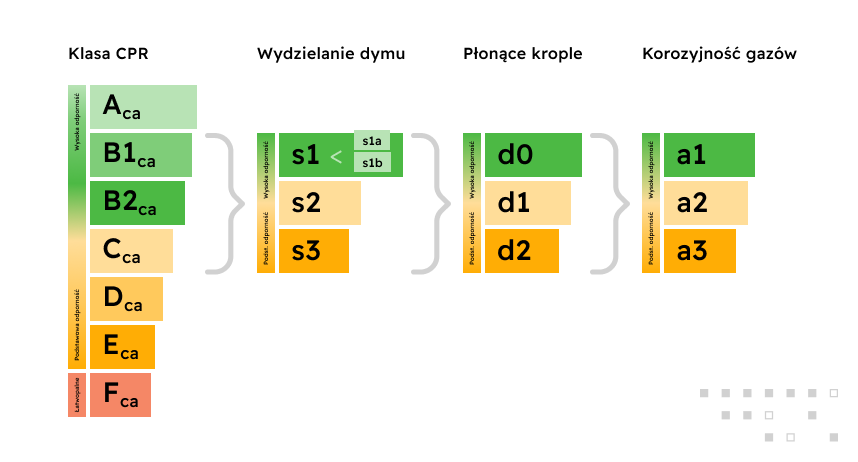
CPR classes refer to the reaction to fire and level of smoke emission, both of which are essential for building fire safety. These classifications apply to cables and wires designed for permanent installation in residential, commercial, and industrial buildings.
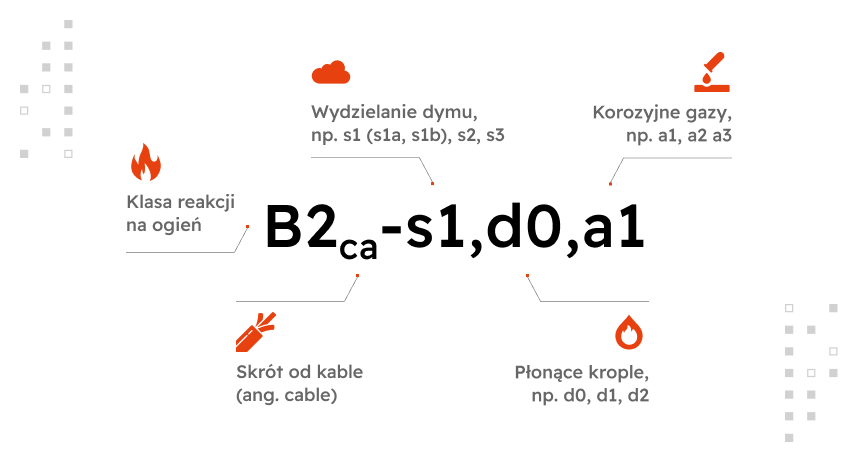
B2ca -s1a, d0, a1 – what do the symbols shown on our cable packaging represent?
These markings are crucial for fire safety. Here’s what you need to know!
Every cable placed on the market and intended for permanent installation in a building must undergo appropriate testing. Based on the results, the product is assigned a fire performance class (such as B2ca, Cca, Dca), as well as additional classifications:
s – smoke emission
d – flaming particles
a – emission of corrosive gases
The final classification includes the fire performance class along with additional parameters—but what exactly do they represent?
S (smoke) – Smoke emission classification category
Smoke emission is one of the key factors affecting safety during a fire. Smoke reduces visibility and can cause poisoning, which is why it is important for cables to emit as little of it as possible.
Test method: The tests are carried out in special 3 × 3 × 3 meter chambers where the cables are burned. The chamber is equipped with a photometric system consisting of a light source and a sensor positioned on the opposite side. It measures how much light passes through the smoke generated during combustion—the denser the smoke, the less light reaches the sensor. Additionally, parameters such as the smoke production rate (SPR) and total smoke production (TSP) are measured.
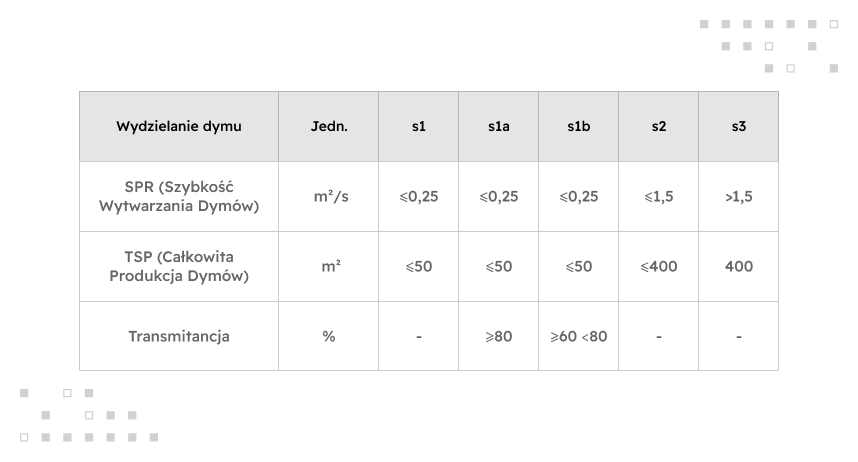
s1: Cables emit very little smoke.
s1a: Very low smoke emission. Smoke production rate (SPR) ≤ 0.25 m²/s, total smoke production (TSP) ≤ 50 m², smoke transmittance ≥ 80%.
s1b: Low smoke emission. Smoke production rate (SPR) ≤ 0.25 m²/s, total smoke production (TSP) ≤ 50 m², smoke transmittance between 60% and 80%.
s2: Medium smoke emission. Smoke production rate (SPR) ≤ 1.5 m²/s, total smoke production (TSP) ≤ 400 m².
s3: High smoke emission. Smoke production rate > 1.5 m²/s, total smoke production (TSP) > 400 m².
D (drops) – Flaming droplets classification category
Flaming droplets can spread fire, which is why their quantity and burning duration are strictly controlled.
Test method: The cables are exposed to a burner flame, and the observation is carried out in a dedicated test chamber. During the test, the duration for which flaming droplets or particles are emitted is measured. To qualify for class d1, the droplets must not burn for more than 10 seconds within a 1,200-second test period. The test is conducted under controlled conditions, with the cable positioned vertically and the flame applied for a specified period of time.
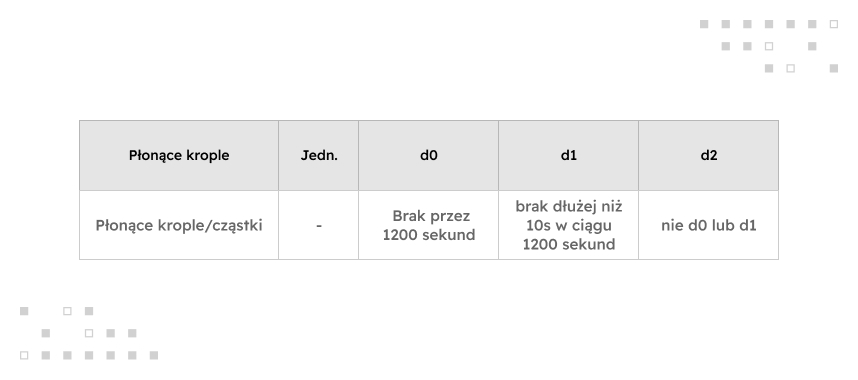
d0: No flaming droplets or particles are produced for 1,200 seconds.
d1: Flaming droplets or particles may be emitted, but not for longer than 10 seconds within a 1,200-second period.
d2: Flaming droplets or particles may be emitted for longer than 10 seconds.
A (acidity) – Classification of acidity (corrosive gases)
Corrosive gases generated during combustion can damage electronic equipment and be harmful to health.
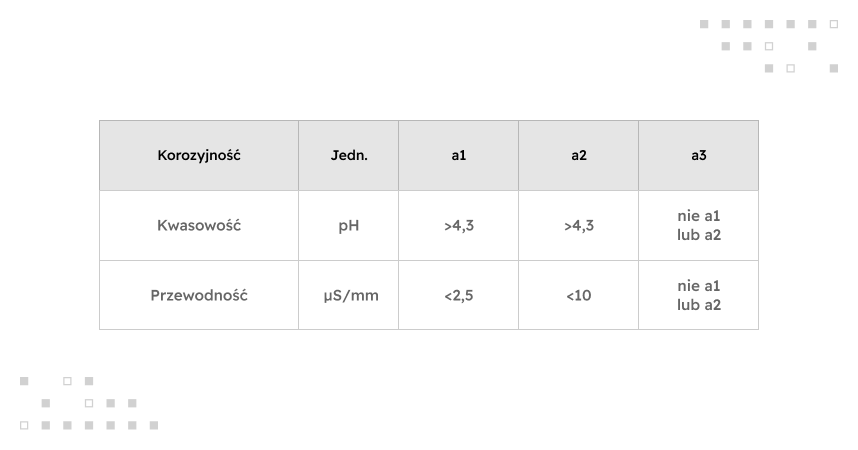
Test method: A cable sample is burned in a furnace at a temperature of 935°C. The resulting gases are carried by an airflow into scrubbers filled with distilled water. The aqueous solutions of the combustion gases are then collected and analyzed for acidity (pH) and electrical conductivity. The test result is considered positive if the pH value is higher than 4.3 and the conductivity is lower than 2.5 μS/mm.
a1: Very low emission of corrosive gases. Acidity (pH) > 4,3 conductivity < 2,5 μS/mm.
a3: High emission of corrosive gases. AciditypH ≤ 4,3 and conductivity ≥ 10 μS/mm.
Why is this important for fire safety?
Choosing cables with appropriate classifications is crucial for ensuring safety in public buildings and other environments that require a high standard of fire protection. Lower smoke emission, the absence of flaming droplets, and minimal release of corrosive gases can save lives and reduce material damage in the event of a fire.
Get exclusive access to product updates, and valuable industry insights to simplify your installations. Stay ahead of the curve with our newsletter, as we continually expand our product range.